
Bali furniture export is a well-established industry serving buyers across North America, Europe, Australia, and Asia. Thousands of containers leave Indonesian ports every year, carrying sofa sets, dining tables, sun loungers, daybeds, and custom hospitality furniture to hotels, retailers, interior designers, and private buyers around the world.
If you are researching how to export furniture from Bali, or how to source and receive a shipment as a buyer, this guide covers the full process. You will understand why Bali furniture is worth exporting, what the logistics look like, what documentation you need, what it costs, and how to find a supplier who makes the process straightforward.
Why Bali Furniture Exports to Over 100 Countries
Bali furniture has earned its global reputation through a combination of factors that are difficult to replicate in other markets.
The raw materials are here. Indonesia holds some of the world’s largest FSC-certified teak plantations, managed by Perhutani, the government-owned forestry enterprise. Indonesia is also one of the world’s largest rattan producers and holds a government-enforced ban on raw rattan export, which keeps value-added furniture manufacturing inside the country. Buyers who import from Bali access the finished product directly from the source of the material.
The craft skills are here. Bali’s furniture artisans work in traditions passed down across generations. Rope weaving, wicker construction, teak joinery, and powder-coat finishing are done in-house by skilled workers, not by automated production lines. This level of handcraft is what makes Bali furniture identifiable in a global market.
The price is competitive. Factory-direct pricing from a Bali manufacturer removes the importer, wholesaler, and distributor margins that buyers pay when purchasing from their home-country supply chains. Even after adding freight and import duties, buyers consistently save 40 to 60 percent compared to equivalent retail prices in the US, Europe, and Australia.
The export infrastructure is established. Manufacturers who have been exporting for years know the documentation, the freight forwarders, the customs requirements for different destination countries, and the lead times involved. This reduces the risk and friction of an international purchase for the buyer.
What Gets Exported from Bali
Bali furniture exports span a broad product range. The most active export categories are:
Outdoor sofa sets using rope weaving, wicker, or teak combined with powder-coated aluminium frames. These are the highest-volume category for hotel, villa, and residential buyers across Australia, the US, and Europe.
Sun loungers and daybeds for pool decks, beach clubs, and resort areas. Sling loungers using Phifertex fabric on aluminium frames are popular for commercial hospitality buyers. Teak loungers serve the premium residential and boutique resort segment.
Dining chairs and tables in teak, aluminium, and wicker combinations. Both residential dining sets and commercial restaurant furniture ship in volume to buyers globally.
Upholstered outdoor furniture using Sunbrella fabric and quick-dry foam. This category serves buyers who want maximum comfort alongside weather performance.
Bar furniture, side tables, accessories, and cushion covers round out most container shipments as fill items alongside larger pieces.
How to Export Furniture from Bali: The Full Process
Whether you are a first-time buyer or a commercial importer placing your tenth container order, the export process from Bali follows a consistent structure.
Step 1: Identify and Qualify Your Supplier
The export process starts with the right supplier. Not every furniture seller in Bali has export experience. Look for manufacturers who:
Export regularly to your destination country. A factory that ships 500 containers per year to Europe and the US has already solved the documentation, certification, and logistics challenges you will face.
Hold FSC certification or SVLK documentation for teak products. The US Lacey Act, EU Timber Regulation, and Australia’s Illegal Logging Prohibition Act all require legal timber certification for wood furniture imports. Suppliers who cannot provide this documentation create compliance risk at your destination port.
Manufacture in-house rather than sourcing from subcontractors. In-house production gives the manufacturer direct control over quality and timeline. Third-party sourcing introduces variables that are harder to manage from the buyer’s end.
Visit the showroom if possible. Bali’s furniture showrooms allow you to assess material quality, finish consistency, and dimensional accuracy before committing to a container order.
Step 2: Place Your Order and Confirm Specifications
Once you have selected your supplier, confirm every detail in writing before production begins. Your order confirmation should include the item names and model references, quantities per item, agreed dimensions, material specifications including fabric codes or finish references, total order value, payment schedule, and agreed production timeline.
For teak furniture, specify FSC-certified teak explicitly. Cushioned pieces, confirm whether Sunbrella or an equivalent outdoor fabric is used. And for rope-woven pieces, confirm that the rope is UV-stabilised polypropylene rather than standard PP rope that degrades under sun exposure.
Payment terms are typically a deposit of 30 to 50 percent on order confirmation, with the balance due before shipment. Confirm the exact terms before production starts.
Step 3: Export Documentation from Bali
This is where first-time exporters most often encounter problems. Bali furniture export requires specific documentation to clear customs at your destination. Your supplier handles most of these documents on the Indonesian side. You need to understand what each document is and verify that it is complete before shipment.
Commercial Invoice: Itemised list of goods, quantities, unit prices, and total value. This is used to calculate import duties at the destination.
Packing List: Detailed list of what is in each carton or package, including dimensions and weights. Customs inspectors use this to verify the shipment contents.
Bill of Lading (sea freight) or Airway Bill (air freight): The primary transport document issued by the shipping line or airline. It serves as a receipt for the goods and the contract of carriage.
Certificate of Origin: Issued by the Indonesian Chamber of Commerce (KADIN), this confirms that the goods originate from Indonesia. This is required to access preferential duty rates where applicable and for general customs clearance.
SVLK Certificate: For any shipment containing wood products, the SVLK (Sistem Verifikasi Legalitas Kayu) timber legality document confirms that the wood is legally sourced. This is mandatory for Indonesian wood exports and is required for compliance with timber import regulations in the US, EU, and Australia.
FSC Certificate: If the teak is sourced from FSC-certified plantations, the supplier can provide FSC chain-of-custody documentation. Some buyers, particularly those in Europe, specifically require FSC rather than SVLK.
Phytosanitary Certificate: Required for some destination countries when shipping natural materials including wood and rattan. Your freight forwarder will advise whether this applies for your specific destination.
Step 4: Choose Your Freight Method
Two primary freight options apply for Bali furniture export.
Sea freight is standard for all but the smallest urgent orders. Furniture is bulky and heavy, and air freight for furniture quantities is rarely economically justifiable.
Less-than-Container Load (LCL) shipments consolidate your goods with other buyers’ cargo in a shared container. You pay for the cubic meters your goods occupy. LCL suits buyers whose order does not fill a full container. The freight forwarder manages consolidation.
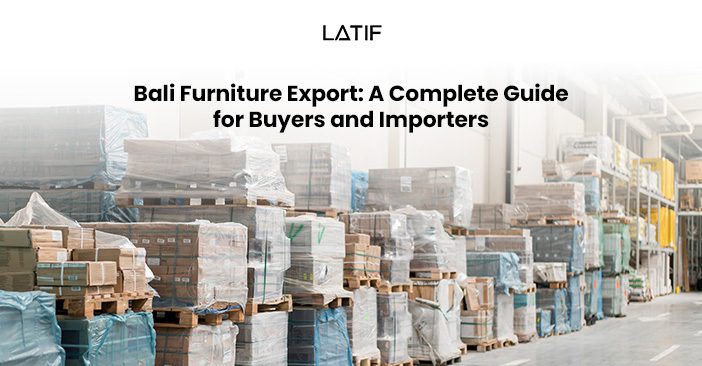
Full Container Load (FCL) gives you exclusive use of a 20-foot or 40-foot container. A 20-foot container holds approximately 25 to 30 cubic meters. A 40-foot container holds approximately 55 to 65 cubic meters. FCL is more cost-effective per cubic meter once your order fills 70 percent or more of a container, and it reduces the risk of transit damage because your goods are not mixed with others.
The main port for Bali furniture export is Benoa Port in Bali, with some shipments routing through Tanjung Perak in Surabaya, East Java. Your freight forwarder handles the port booking, container arrangement, and connection to the shipping line.
Step 5: The Undername Export Option for Smaller Buyers
If you are an individual buyer or a business without an Indonesian export company, you have a practical option called undername export. Under this arrangement, a licensed Indonesian export company exports the goods on your behalf using their export licence. You do not need to set up your own Indonesian entity.
The undername export company handles customs clearance on the Indonesian side, manages the export documentation, and hands the shipment to the freight forwarder for international transit. You receive the goods at your destination as the named consignee.
This is the most accessible route for first-time buyers, interior designers importing pieces for a single project, or individuals shipping furniture from a Bali holiday purchase.
Alternatively, businesses with regular high-volume export needs can establish their own Indonesian entity. Setting up a foreign-owned company (PT PMA) with an export classification allows you to manage your own export operations, but this process takes 6 to 8 months minimum and involves capital requirements and regulatory steps that only make sense at sufficient volume.
Step 6: Customs Clearance at Destination
At the destination port, your customs broker files the import declaration, pays applicable duties and taxes, and coordinates with customs authorities to release your shipment.
The import duty rate for furniture from Indonesia varies by country. The US applies a 0 percent duty on most wooden furniture from Indonesia. The EU applies approximately 2.7 percent. Australia has largely eliminated furniture import duties. Check your country’s current tariff schedule before your order to calculate landed cost accurately.
VAT or GST applies on imports in most countries, on top of any import duty. In Australia, 10 percent GST applies. In the UK, 20 percent import VAT applies. And in Singapore, GST applies on goods above the import value threshold.
Have all your documents organised and available to your broker before the shipment arrives at port. Missing or incomplete documentation is the most common cause of customs delays.
Step 7: Delivery to Final Destination
Once customs releases the shipment, local trucking moves the goods from the port to your address. For large container loads, a tail-lift truck and the ability to offload heavy furniture will be needed at the delivery address.
Inspect every piece on delivery. Photograph any transit damage immediately and notify your supplier and freight forwarder in writing within the timeframe specified in your shipping contract. Reputable manufacturers and freight providers carry cargo insurance that covers transit damage claims.
Estimated Cost of Bali Furniture Export
Budget these costs in addition to your furniture purchase price.
Export packaging in Bali: IDR 50,000 to IDR 200,000 per piece, depending on size and complexity.
Inland transport from factory to Bali port: USD 100 to USD 300 per container or LCL shipment.
Port handling and export fees: USD 150 to USD 400.
Sea freight LCL: USD 80 to USD 200 per cubic meter for short routes such as Bali to Singapore or Australia. USD 150 to USD 350 per cubic meter for longer routes to Europe or North America.
Sea freight FCL 20-foot container: USD 1,500 to USD 3,000 to Singapore or Australia. USD 3,000 to USD 6,000 to North America. USD 2,500 to USD 5,000 to Europe.
Destination port handling: USD 200 to USD 500.
Customs brokerage: USD 150 to USD 400.
Import duties: 0 to 5.7 percent of customs value depending on country and product classification.
Local delivery: USD 100 to USD 500 depending on volume and distance.
As a working estimate, budget 25 to 40 percent on top of your FOB furniture price to cover total landed cost for a small-to-medium LCL shipment to Australia, Singapore, or Europe.
Common Mistakes in Bali Furniture Export
Skipping timber certification. This creates compliance risk at destination ports in regulated markets. Always confirm SVLK or FSC documentation before shipment leaves Bali.
Underestimating lead times. Production of 4 to 8 weeks plus sea transit of 3 to 8 weeks depending on destination means your furniture can take 3 to 4 months from order to delivery. Build this into your project timeline.
Not requesting samples for large orders. Material quality in photos and material quality in hand are not always the same. For orders over USD 10,000, request physical material samples before approving production.
Choosing the wrong freight type for your order size. LCL for small orders, FCL when your order approaches or fills a container. The cost difference per cubic meter is significant.
Working without a licensed customs broker at destination. Attempting to self-clear imported furniture at destination ports is possible in some markets but creates risk. A broker who knows your market’s requirements is worth the cost.
Export Furniture from Bali with Latif Living
Latif Living has been exporting outdoor furniture from Indonesia since 2004. Their factory in Kediri, East Java produces over 30 tons of raw material per month across 10 all-weather rope machines, 6 resin fibre extruders, and dedicated teak, aluminium, cushion, and weaving production lines. They ship up to 600 containers per year to buyers across North America, Europe, Asia, and Oceania.
All teak is FSC-certified, sourced from Perhutani’s sustainable plantations. SVLK documentation is standard on all wood product exports. Cushion fabric uses Sunbrella. Sling uses Phifertex. Rope uses Clariant UV-stabilised polypropylene. These material specifications meet the requirements of buyers in markets with strict timber import compliance and high commercial quality standards.
Their export team handles production documentation, SVLK and FSC certificates, commercial invoices, packing lists, and can coordinate with freight forwarders familiar with Bali-to-destination shipping routes. For buyers who want a supplier that understands the export process as well as the product, Latif Living’s track record across 100-plus countries is the most direct evidence available.
Visit their showrooms in Bali to review the 2025 collection, discuss your project requirements, and start your export order.
Latif Living Sanur Jl. By Pass Ngurah Rai No.125 X, Sanur, Denpasar Selatan, Bali +62 811-3886-034
Latif Living Seminyak (Kerobokan) Jl. Raya Kerobokan No.132, Kerobokan, Kuta Utara, Badung, Bali +62 812-2534-9473