
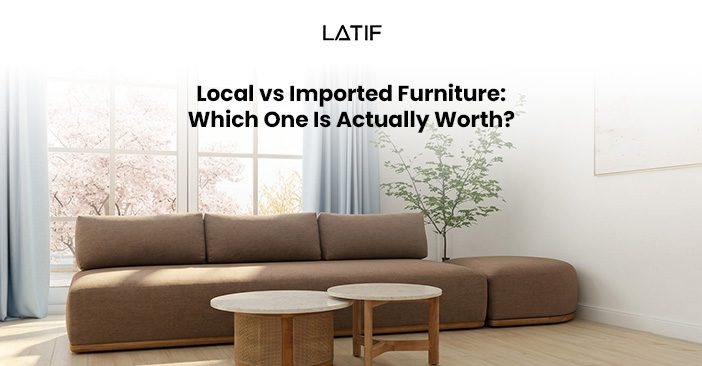
When you shop for furniture, you will encounter two competing claims on almost every showroom floor. One seller tells you their pieces are imported, implying a quality that local production supposedly cannot match. Another tells you their furniture is locally made, implying craftsmanship and value that imported goods cannot offer. Both arguments contain truth. Both local vs imported furniture are also, at times, used to sell you an origin story rather than a piece of furniture.
The local vs imported furniture debate is real, but it is also frequently oversimplified. This guide cuts through the noise, lays out the genuine trade-offs on both sides, tells you what questions actually matter, and explains why Indonesian-made furniture specifically sits in a category of its own for outdoor and tropical living.
What “Local” and “Imported” Actually Mean
“Local” means different things in different markets. In Singapore, it typically refers to furniture made in Malaysia or assembled in Singapore. Australia, it means furniture produced domestically, which is a relatively small manufacturing base. And Europe, local usually signals a preference for domestic or regional EU production.
“Imported” is equally broad. Furniture arrives from Italy, Scandinavia, Japan, China, Vietnam, Indonesia, Malaysia, and India. The quality range within any one of those origins is enormous. A piece labelled “imported from Italy” could be a masterwork of upholstery craftsmanship or a container-fill item dressed up with a European-sounding name.
The label alone tells you almost nothing. What matters is the specific factory, the specific materials, and the quality controls in place.
The Real Trade-Offs: Local vs Imported Furniture
Price
Local furniture generally costs less at the retail level. Shorter supply chains mean lower freight costs, fewer import duties, and reduced distribution margins. For buyers in the same country as the manufacturer, this is a genuine advantage.
Imported furniture carries those extra costs regardless of where it sits in the quality spectrum. Some of that cost reflects genuine craftsmanship and premium materials. Some of it is purely supply-chain markup. A piece of Italian furniture that retails for USD 3,000 in Sydney may have a factory-gate cost of USD 400, with USD 2,600 spread across freight, duties, distributor margin, and brand premium. The price does not always reflect the product.
Lead Times
Local furniture typically delivers faster. A manufacturer in the same country or region can ship in days to a few weeks. Sea freight from Europe to Australia takes 6 to 10 weeks. Air freight is faster but pushes cost up significantly.
For homeowners working to a renovation deadline or a hotel opening date, lead time is a real constraint that imported furniture imposes and local furniture reduces.
Customisation
Local and regional manufacturers generally offer more practical customisation flexibility. When a factory is nearby and the retailer has a direct relationship with it, adjusting dimensions, finishes, fabrics, and configurations is genuinely easier. International shipping means that changes after production begins are costly and slow.
For commercial buyers furnishing hotels, restaurants, or large residential projects, customisation access is often the deciding factor.
After-Sales Support
If a mechanism fails on an imported sofa 18 months after purchase, sourcing a replacement part from a European factory adds time, shipping cost, and uncertainty. Local manufacturers and regional suppliers handle warranty claims, replacement parts, and repairs through accessible channels.
For high-use commercial furniture in particular, after-sales support is not a minor consideration. It determines how quickly a problem gets resolved and how much downtime a property experiences.
Material Quality and Climate Fit
This is where the conversation gets more specific and where the “local vs imported” frame breaks down.
Material quality is a factory decision, not a geography decision. A locally-made sofa using low-density foam and a staple-gun frame will fail faster than an imported sofa using kiln-dried hardwood and high-resilience foam. The origin is irrelevant. The construction is everything.
Climate compatibility matters more than origin for buyers in tropical environments. Furniture designed and tested in Northern European climates, where indoor humidity runs 30 to 50 percent, behaves differently in tropical settings where humidity sits at 70 to 90 percent year-round. Solid wood species that perform well in dry climates can expand, contract, and warp when introduced to constant tropical moisture. This is a real phenomenon, and it is not always disclosed in imported furniture sales.
Design and Aesthetic Range
High-end European furniture carries genuine design heritage in certain categories. Italian upholstered seating, Scandinavian solid wood joinery, and Japanese craft furniture represent real design traditions with real quality. These are valid reasons to import.
However, for outdoor furniture, tropical living, and hospitality environments, the design traditions that matter most are not European. They are Indonesian, Thai, and Balinese. The aesthetic language of teak, rattan, wicker, and natural fibre outdoor furniture was developed and refined in Southeast Asia, not Northern Europe. Importing this category from Europe makes no logical or economic sense when the source of both the craft tradition and the raw material is Indonesia.
Where Imported Furniture Wins
Imported furniture is the right choice in specific situations.
When the product category has a genuine home origin. Italian leather upholstery, Scandinavian solid birch or oak furniture, and Japanese joinery traditions represent craftsmanship that reflects generations of accumulated practice in that specific material and construction type. The origin adds real value here.
When the design is not available locally. Certain contemporary design pieces from European brands represent genuine design innovation that local manufacturers have not replicated. If a specific design matters to you and it is only available as an import, that is a valid reason to pay the premium.
When the buyer’s market lacks qualified local production. In some markets, local furniture manufacturing capacity is thin, and import fills a genuine gap in quality or design.
Where Local and Regional Manufacturing Wins
Regional manufacturing wins more consistently than imported in these situations.
Outdoor and tropical furniture. For any buyer in a tropical, coastal, or high-humidity environment, furniture manufactured in the same climate zone, using materials suited to that climate, made by artisans with generations of experience working those materials, outperforms furniture designed for different conditions. Indonesian outdoor furniture for tropical environments is the most obvious example of this principle.
Large commercial projects. Hotels, resorts, restaurants, and villa developers buying hundreds of pieces benefit from the pricing, customisation flexibility, lead time, and after-sales support that regional manufacturers provide. Importing a container of dining chairs from Italy for a Bali hotel makes no practical or economic sense when the world’s best outdoor furniture for that environment is made 200 kilometres away.
Volume purchases with standard specifications. When a buyer needs 50 identical dining chairs, regional manufacturers can produce to specification, match dimensions, ensure consistency across the batch, and deliver without the logistics complexity of international shipping.
The Question Both Local vs Imported Furniture Sides Avoid
Neither the local manufacturer nor the importer will readily tell you that the most important variable is not where the furniture was made. It is who decided what it was made of.
Before buying any piece, imported or local, ask these questions.
What is the frame material? Solid hardwood, engineered wood, and metal behave differently over time. In high-humidity environments, engineered wood products swell and delaminate. Solid teak, solid aluminium, and powder-coated steel do not.
For outdoor pieces, what is the seat material? Phifertex sling and Sunbrella fabric are commercial-grade outdoor materials. Generic polyester fabrics fade and mildew within a year of outdoor use.
Is the wood certified? For teak specifically, FSC certification and SVLK (Indonesia’s mandatory timber legality verification) confirm legal, sustainable sourcing. This matters for import compliance in the US, EU, and Australia, and it reflects responsible production practice.
What are the UV protection measures in synthetic materials? Good-quality HDPE wicker and polypropylene rope use Clariant UV-protective additives. Materials without UV protection fade visibly within one to two seasons of sun exposure.
A supplier who cannot answer these questions specifically, regardless of where the product was made, is selling an origin story rather than a piece of furniture.
Indonesian Furniture: A Special Case in the Local vs Imported Furniture Debate
For buyers in Asia, Australia, the Middle East, and beyond who are sourcing outdoor, tropical, or hospitality furniture, Indonesian furniture occupies a unique position in the local vs imported debate.
From the buyer’s perspective in Sydney, Singapore, Dubai, or Los Angeles, Indonesian furniture is imported furniture. But it is not imported in the same way that European furniture is imported. The difference is this: Indonesia is the source of the raw material, the craft tradition, and the most relevant climate context for the product category.
Teak grows in Indonesia’s government-managed Perhutani plantations. Indonesia is one of the world’s largest rattan producers. The artisan workforce in Jepara, Bali, and Kediri has spent generations developing expertise in wood carving, wicker weaving, rope weaving, and outdoor furniture construction. The climate in which Indonesian outdoor furniture is produced and tested is identical to the climate in which it will be used in tropical destinations globally.
When you import outdoor furniture from Indonesia, you are not paying a premium for a supply-chain origin story. You are accessing the closest thing to a local manufacturer for that product category, wherever you live in the tropics or subtropics.
Why Latif Living Represents the Best of Both
Latif Living has manufactured outdoor furniture in Kediri, East Java since 2004, with retail showrooms in Bali serving international buyers directly. Their model combines the material advantages of Indonesian production with the accessibility of a direct-purchase showroom experience.
From a material specification standpoint, everything is disclosed. FSC-certified teak from Perhutani’s sustainably managed plantations. Sunbrella fabric for cushions. Phifertex for sling. Clariant UV-stabilised polypropylene for all-weather rope. Powder-coated aluminium frames.
From a production standpoint, vertical integration means quality control happens in-house. The factory runs 10 all-weather rope machines, 6 resin fibre extruders, and dedicated production lines for teak, aluminium, cushion, and weaving. Over 30 tons of raw material is produced monthly. Up to 600 containers ship per year to buyers across North America, Europe, Asia, and Oceania.
For buyers who want to know exactly what they are getting and why it is worth the cost, both questions have direct answers.
As a trusted Bali furniture destination, Latif Living allows buyers to inspect materials, craftsmanship, and construction firsthand before placing an order.
Visit Latif Living’s showrooms in Bali to see and assess the material quality in person before committing to any order.
Latif Living Sanur Jl. By Pass Ngurah Rai No.125 X, Sanur, Denpasar Selatan, Bali
Latif Living Seminyak (Kerobokan) Jl. Raya Kerobokan No.132, Kerobokan, Kuta Utara, Badung, Bali