
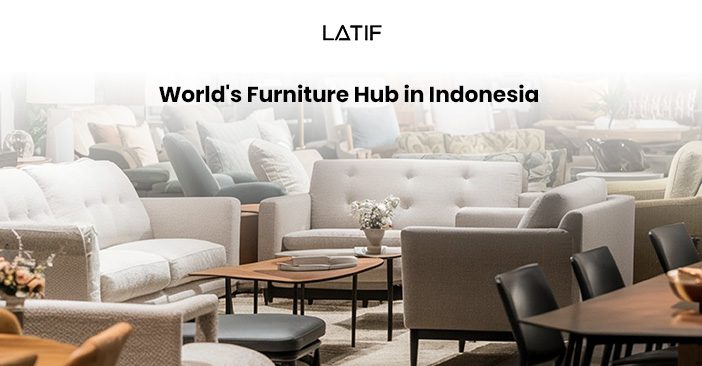
When people talk about the world’s furniture hub, two names dominate the conversation: China and High Point, North Carolina. China for volume, High Point for trade. Both have earned their status. But a third contender has been growing quietly and consistently for decades, one that offers something neither China nor High Point can fully replicate: Indonesia.
Indonesia is not trying to compete on mass production. It occupies a different and harder-to-replicate position. Premium handcrafted furniture from certified hardwood, natural fibre, and sustainable materials, made by artisans whose skill spans generations. Bought by hotels, retailers, and interior designers across North America, Europe, Australia, and Asia.
This article explains why Indonesia is emerging as one of the world’s most important furniture hubs, which regions drive that claim, and why Bali specifically has become the entry point for buyers around the world.
The Numbers Behind Indonesia’s Furniture Industry
Indonesia’s furniture industry is not a niche export category. It is a structured, growing, and government-prioritised sector.
Indonesia’s furniture exports reached USD 2.5 billion in 2022. The sector’s industry body, HIMKI, has set a target of reaching USD 6 billion in furniture and handicraft exports by 2030.
Indonesia’s furniture and handicraft exports reached USD 2.22 billion from January to November 2024. That global market share figure of 2.37 percent understates its influence, particularly in the premium handcrafted and teak segments.
The context matters. Asia accounts for roughly 60 percent of global furniture exports. China’s furniture sector alone generated over USD 160 billion in domestic market value in 2025. Vietnam reached USD 17.6 billion in wood and furniture exports in 2024. Indonesia’s figures look modest by comparison, but that comparison misses the point entirely.
Indonesia does not compete where China competes. It competes on provenance, material quality, artisanal differentiation, and certification. When a US retailer sources a carved teak dining table from Jepara, the joinery technique used by that factory worker was most likely taught by their parents, who learned from their grandparents. That depth of craft tradition is not something a high-volume factory can manufacture.
The global furniture market is on a positive trajectory, with US-based consultancy firm Expert Market Research forecasting an average annual growth rate of 4.9 percent between 2025 and 2034, building from a market value of USD 660 billion in 2024. Indonesia’s manufacturers are well-positioned to capture the premium segment of that growth.
The Indonesia furniture market size surpassed USD 7.8 billion in value in 2024 and is projected to reach approximately USD 15.2 billion by 2032. The combination of export strength and a growing domestic market makes Indonesia’s furniture sector one of the most dynamic in Southeast Asia.
Why Indonesia Holds a Position to be World’s Furniture Hub
Three factors create Indonesia’s furniture advantage that neither China nor India can easily replicate.
Teak
Indonesia is home to some of the world’s largest and most important certified teak plantations. Perhutani, the Indonesian government-owned forestry enterprise, manages sustainably farmed teak plantations across Java. This gives Indonesian furniture manufacturers direct, legally certified access to one of the world’s most valuable furniture woods.
Teak’s natural properties are well documented. Its high silica content makes it resistant to moisture, insects, and weathering. FSC-certified Indonesian teak clears customs in the US under the Lacey Act, in the EU under the EU Timber Regulation, and in Australia under the Illegal Logging Prohibition Act. No other country offers government-managed teak at this scale and with this level of international certification infrastructure.
Rattan and Natural Fibre
Indonesia is one of the world’s largest rattan producers. Rattan is a fast-growing vine that is harvested from tropical forests and processed into furniture frames, woven panels, and decorative finishes. Indonesia’s government banned raw rattan exports to keep value-added manufacturing inside the country. The result is that Indonesian furniture makers control the full supply chain from raw material to finished export product.
Skilled Artisan Workforce
Indonesia’s furniture workforce carries centuries of embedded skill in wood carving, weaving, joinery, and surface finishing. This is not a generalisation. It is a historically documented reality visible in specific cities and regions that have built their entire economic identity around furniture production.
Indonesia’s Three Main Furniture Production Centres
Understanding Indonesia as a world’s furniture hub requires understanding its geography. Three regions stand out, each with a distinct character and product category.
Jepara, Central Java: Indonesia’s Wood Carving Capital
Jepara is Indonesia’s most recognised furniture city globally. Located on the north coast of Central Java, it has been a woodcarving centre for over four centuries. The region’s history as a carving hub predates colonial trade. Workshops in Jepara’s villages produce carved teak furniture, mahogany pieces, and intricate wooden decorative items that are exported to Europe, the Middle East, the US, and Australia.
Jepara specialises in indoor furniture. Bedroom sets, carved dining tables, console tables, wardrobes, and decorative cabinets are its core products. The level of hand carving detail available from Jepara workshops is genuinely difficult to source at scale anywhere else in the world at competitive pricing.
Buyers looking for traditional Indonesian wood furniture, ornate carving, or heritage-style indoor furniture will find Jepara to be the primary destination. The city hosts hundreds of furniture manufacturers ranging from small family workshops producing custom pieces to large factories with export infrastructure serving European retailers.
Kediri, East Java: Natural Fibre and Mid-Range Production
Kediri is less internationally known than Jepara or Bali, but it is a serious production centre for rattan, rope-woven, and natural fibre furniture. The region produces outdoor and indoor furniture using synthetic wicker, resin fibre, and polypropylene rope woven over aluminium or steel frames.
Kediri manufacturers serve the mid-range market particularly well. Their products compete effectively on price while meeting the material and quality standards required by European and Australian importers. The region is gaining recognition in Europe as a sourcing destination for volume outdoor furniture orders.
For buyers seeking competitive pricing on wicker, rope-woven, or aluminium-frame outdoor furniture in medium-to-large quantities, Kediri represents strong value relative to equivalent products sourced from China or Vietnam.
Bali: Design, Aesthetics, and the Global Gateway
Bali occupies a different position from Jepara and Kediri. It is not primarily a production city. It is a design and export gateway, and it is the name that international buyers recognise first when they think about Indonesian furniture.
Bali’s furniture scene developed in parallel with its tourism industry. As international visitors arrived and villa culture grew, demand for aesthetically distinctive outdoor and tropical-style furniture created a cluster of design-forward manufacturers and showrooms. Over time, these manufacturers built export operations serving hospitality buyers, interior designers, and retailers globally.
Bali furniture is defined by its aesthetic language. Teak, aluminium, rope weaving, wicker, and natural materials combined into modern outdoor furniture with a tropical design sensibility. The pieces look at home beside an infinity pool, on a villa terrace, or in a boutique hotel garden. This aesthetic travels globally. A dining set made in Bali looks as appropriate in a Sydney harbourside home as it does in a Danish summer house or a Los Angeles courtyard.
The Kerobokan-Seminyak strip in South Bali is particularly dense with furniture showrooms. The Sanur area offers another concentration of outdoor furniture suppliers. These showrooms serve walk-in buyers from around the world who come to Bali specifically to source furniture, as well as trade buyers placing container orders for international shipment.
The demand for furniture was augmented by the growing tourism in Bali, where the setting up of hotels and resorts was among the major market drivers for the wider Indonesian furniture industry. That hotel and resort demand created the quality and design standards that now make Bali furniture competitive globally.
How Indonesia Compares to Other Global Furniture Sources
The honest comparison between Indonesia and China or India is not about which country makes more furniture. It is about what kind of furniture each country makes best.
China dominates volume production. It is the world’s largest furniture manufacturer by far. Its strength is in mass production of MDF, engineered wood, and lower-cost upholstered pieces. Chinese outdoor furniture using aluminium and synthetic wicker exists, but quality control varies across the enormous manufacturing base.
India produces furniture primarily for its large domestic market, with some export in carved wood and contemporary designs. India’s teak supply is more limited than Indonesia’s, and its export infrastructure for furniture is less developed.
Vietnam has grown rapidly in solid wood furniture, particularly for the US market. Vietnam exported USD 9.4 billion worth of furniture to the US market in 2024. Vietnam’s strength is in solid wood processing for indoor furniture. Its outdoor furniture and natural fibre categories are less developed than Indonesia’s.
Indonesia’s specific advantage is in certified teak, natural fibre, and handcrafted outdoor furniture with international quality certification. For buyers whose product proposition centres on provenance, sustainability, and artisanal quality rather than lowest-cost volume, Indonesia offers what China and Vietnam cannot.
The Certification Advantage
Indonesia’s timber certification infrastructure is a genuine competitive advantage that takes years to build and maintain.
SVLK (Sistem Verifikasi Legalitas Kayu) is Indonesia’s mandatory timber legality verification system. All teak exported from Indonesia must carry SVLK documentation. This satisfies the EU Timber Regulation, clears US Lacey Act requirements, and meets Australian import standards for legal wood.
FSC (Forest Stewardship Council) certification is additionally available from manufacturers sourcing from Perhutani’s certified plantations. FSC certification is the international gold standard for responsible forest management and is increasingly required by European retailers.
For buyers importing into markets with strict timber import regulations, the combination of SVLK and FSC certification available from Indonesian manufacturers removes compliance risk that can emerge when sourcing from less regulated origins.
Bali as the Entry Point to World’s Furniture Hub in Indonesia
For international buyers, Bali serves a function beyond its own furniture production. It is the most accessible, internationally connected, and commercially mature entry point into Indonesia’s furniture ecosystem.
Bali is the name buyers recognise. Its international airport handles direct flights from major hubs across Asia, Australia, and beyond. Its showroom infrastructure is built to serve international buyers, with English-speaking sales teams, export documentation experience, and logistics partners familiar with shipping to the US, Europe, and Australia.
A buyer who visits Bali’s showrooms and places an order may receive furniture produced partly in Bali’s own workshops, partly in Kediri, and partly using teak from Jepara-adjacent suppliers. The best Bali-based manufacturers have integrated supply chains that draw on Indonesia’s full furniture production geography.
This integration is what makes Bali the effective headquarters of Indonesia’s furniture export industry for international buyers. You source in Bali. The manufacturing capability that backs it up spans the whole archipelago.
Latif Living: As World’s Furniture Hub Through Bali
Latif Living has operated at the intersection of Bali’s design culture and Indonesia’s manufacturing capability since 2004. The company manufactures in Kediri, East Java, drawing on that region’s production depth for rope-woven, wicker, and aluminium furniture, while maintaining two showrooms in Bali as the customer-facing point of contact for international buyers.
Their factory runs 10 all-weather rope machines, 6 resin fibre extruders, and dedicated production lines for teak, cushion, aluminium, and weaving. Over 30 tons of raw material is produced in-house each month. The company ships up to 600 containers per year to buyers across North America, Europe, Asia, and Oceania.
This is the model that defines serious Indonesian furniture export. Design showrooms in Bali as the entry point. Manufacturing infrastructure in East Java as the production backbone. FSC-certified teak from Perhutani. Sunbrella fabric for cushions. Clariant UV protection in resin fibre and rope. Phifertex for sling. Material inputs that meet international hospitality and retail standards.
Their product range covers sofa sets, dining chairs and tables, bar furniture, sun loungers, daybeds, balcony sets, and accessories. Prices range from IDR 1,250,000 for dining chairs to IDR 58,750,000 for large modular sofa systems. Custom sizing, material, and colour are available on request.
For buyers who want to access the world’s furniture hub through Indonesia, Bali is the starting point, and Latif Living offers a direct path from showroom visit to production to global delivery.